

Guide rails are the structural backbone of elevator operation. They define the car and counterweight travel path, provide the braking surface for safety gear, and directly determine ride quality through alignment precision. Incorrect rail specification — wrong model, accuracy grade, or production type — affects every downstream component: guide shoes, safety gear jaw blocks, fishplate hardware, and bracket spacing.
For maintenance contractors sourcing replacement rails and for export projects ordering cut-to-length sections, understanding specification nomenclature is the difference between a smooth installation and a costly field dispute.
This guide covers rail model identification, accuracy grading, material standards, cutting and packaging requirements, installation acceptance criteria, and related component compatibility.
1. Guide Rail Fundamentals
1.1 Function in the Elevator System
Guide rails serve three primary functions:
- Guidance — maintain car and counterweight alignment within the shaft
- Safety — provide the braking surface for safety gear jaw blocks during overspeed events
- Load transfer — distribute car and counterweight forces to shaft brackets and building structure
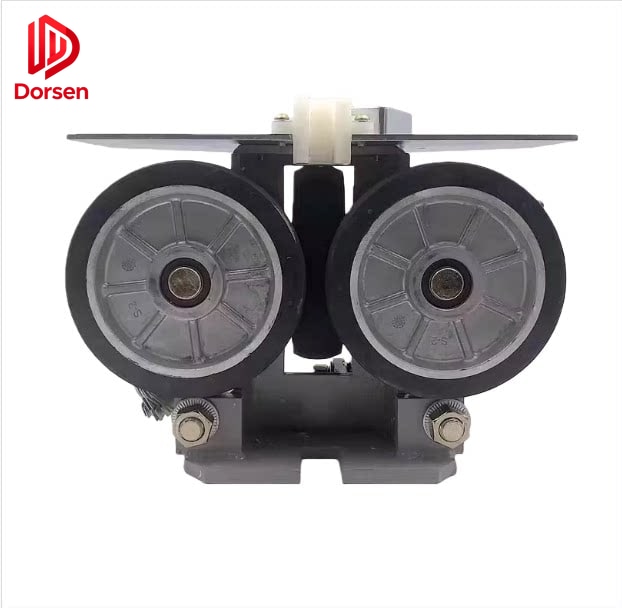
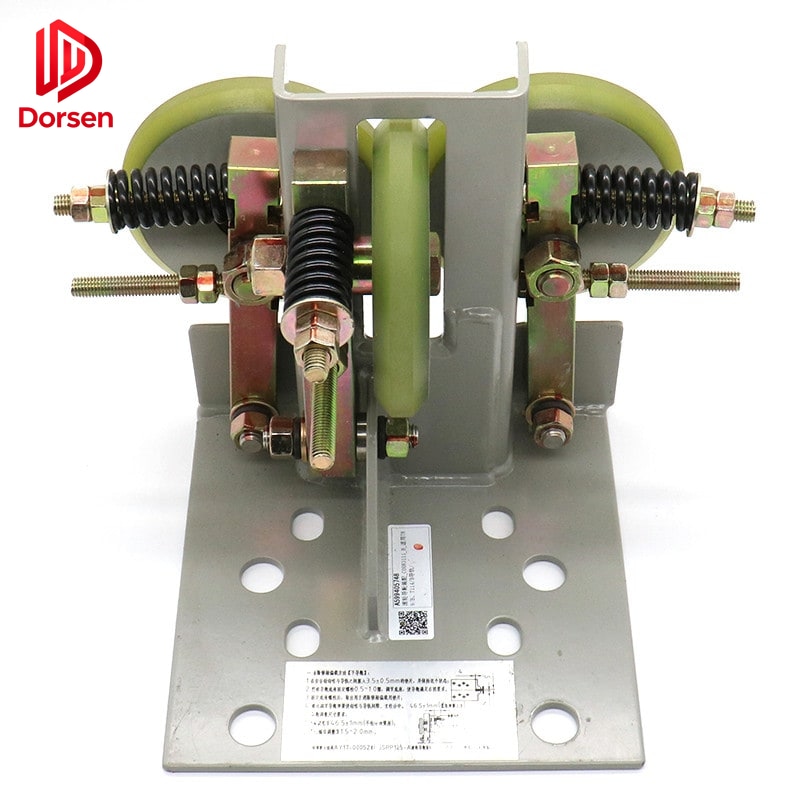
The car guide shoes (or roller guides) ride against the rail working face. Counterweight rails carry a separate set of guide shoes on an independent wear path. Both rail sets must meet specification — replacing car rails without inspecting counterweight rails leaves half the guidance system unaddressed.
1.2 T-Profile Rail Construction
Elevator guide rails use a T-shaped cross-section standardized internationally:
| Dimension | Description | Common values |
|---|---|---|
| Model number | Nominal size designation | T45, T50, T70, T75, T78, T82, T89, T90, T114, T127, T140 |
| b (base width) | Width of the rail foot | Varies by model (e.g., 75 mm for T75) |
| h (overall height) | Total rail height | Varies by model |
| Working face thickness | Dimension safety gear and shoes reference | 9, 10, 14, 16 mm |
| Production type | A = cold-drawn / B = machined | Affects surface finish and safety gear rating |
Cold-drawn rails (Type A) are produced by drawing steel through dies. They are economical and widely used in low-to-medium speed applications. Surface finish is adequate for guide shoes but may require specific safety gear jaw ratings.
Machined rails (Type B) are milled to tighter tolerances with superior surface finish. They are standard for high-speed elevators (> 2.5 m/s) and applications requiring premium ride quality. Safety gear capacity tables often list separate ratings for Type A and Type B rails.
2. Rail Model Identification
2.1 Common Model Families
| Model | Typical application | Speed range |
|---|---|---|
| T45 / T50 | Residential, low-rise | ≤ 1.0 m/s |
| T70 / T75 | Standard passenger | 0.5 – 1.75 m/s |
| T78 / T82 / T89 | Medium-rise passenger | 1.0 – 2.5 m/s |
| T90 / T114 | High-speed passenger | 2.5 – 4.0 m/s |
| T127 / T140 | High-rise, heavy duty | 2.5 – 10+ m/s |
Model number selection is determined by rated speed, car capacity, span between brackets, and building seismic requirements. Replacing rails in an existing shaft typically requires matching the original model exactly — upgrading to a larger profile may require bracket modification.
2.2 Accuracy Grade
Accuracy grade defines straightness and twist tolerances along the rail length. Higher grades provide better ride quality at higher speeds.
| Grade | Straightness tolerance (per meter) | Typical application |
|---|---|---|
| Q1 | ≤ 0.7 mm | General purpose, low speed |
| Q2 | ≤ 0.5 mm | Standard passenger |
| Q3 | ≤ 0.3 mm | Medium-high speed |
| Q8 / Q9 | ≤ 0.16 mm | High-speed, premium ride |
For elevators above 2.5 m/s, accuracy grade Q3 or better is commonly specified. Using Q1 rails on a high-speed installation produces vibration that cannot be corrected by guide shoe adjustment alone.
2.3 Material and Surface Treatment
| Property | Standard practice | Notes |
|---|---|---|
| Material | Carbon steel (typically S235 or equivalent) | Stainless variants for corrosive environments |
| Surface finish | Black (as-rolled) or machined | Machined for Type B rails |
| Anti-corrosion | Oil coating or primer on cut ends | Critical for sea freight export |
| Marking | Model, length, and grade stamped on foot | Required for installation traceability |
3. Cutting and Packaging for Export Projects
3.1 Cut-to-Length Requirements
International rail orders frequently require cutting to floor heights before shipment. Specify the following in every purchase order:
| Requirement | Detail | Why it matters |
|---|---|---|
| Cut length per section | Match floor-to-floor dimension + adjustment | Wrong length causes field cutting delays |
| End squareness | ≤ 0.5 mm deviation from perpendicular | Affects fishplate joint alignment |
| Deburring | All cut edges filed smooth | Prevents installer injury and shoe damage |
| Anti-rust treatment | Oil dip or primer on fresh cut faces | Sea freight causes rapid corrosion without protection |
| Floor-level marking | Label each section with landing number | Speeds site installation in multi-stop shafts |
| Top/bottom identification | Mark which end faces up | Prevents inverted installation |
3.2 Packaging Standards
| Method | Application | Protection level |
|---|---|---|
| Wooden crate | Sea freight, long transit | Highest — prevents bending and impact damage |
| Steel strapping bundle | Short transit, domestic | Moderate — requires careful handling |
| Individual plastic wrapping | Premium rails, Q8/Q9 grade | Prevents surface scratching |
Rails that arrive with untreated cut ends, unmarked lengths, or transit bowing slow installation and increase corrosion risk in humid shafts. Include packaging requirements in the purchase specification — not as an afterthought.
3.3 Fishplate and Hardware Kits
Each rail joint requires:
- Fishplate pair (top and bottom clamp plates)
- High-strength bolts (typically M12, grade 8.8 or 10.9)
- Spring washers or lock nuts per design
- Bracket clips at specified spacing (1,500–2,000 mm typical)
Confirm whether fishplates and hardware are included in the rail quote or ordered separately. Mismatched fishplate geometry for the rail model prevents proper joint closure.
4. Installation Acceptance Criteria
4.1 Verticality and Spacing
| Parameter | Acceptance criterion | Measurement method |
|---|---|---|
| Vertical deviation | ≤ 0.5 mm per 5 m (Q2 grade) | Plumb line or laser |
| Center distance (car rails) | Per design drawing ± 2 mm | Tape measure at multiple heights |
| Rail parallelism | ≤ 1 mm over full travel | Laser alignment system |
| Bracket spacing | 1,500–2,000 mm per design | Tape measure |
EN 81-20 alignment requirements for elevators above 2.5 m/s commonly specify guide alignment within 1.5 mm over any 5-meter section — a tolerance impossible to achieve if individual fishplate joints are loose or misaligned.
4.2 Fishplate Joint Quality
| Parameter | Typical acceptance |
|---|---|
| Gap between rail heads at joint | < 0.15 mm |
| Step offset (vertical mismatch) | ≤ 0.10 mm |
| M12 bolt pre-torque | ~70 N·m |
| M12 bolt final torque | ~140 N·m |
| Surface continuity | Straightedge flush across joint |
Re-torque fishplate bolts after initial settlement is part of many OEM installation sequences. Joint defects are the leading cause of mid-travel vibration and “click” sounds reported after new rail installation.
4.3 Full-Travel Testing
After installation and guide shoe adjustment:
- Run car at inspection speed through full travel — listen for vibration at specific heights
- Map vibration locations to joint numbers — localized noise at one height indicates a joint problem
- Verify safety gear jaw block contact with rail working face (visual inspection)
- Document as-built alignment data for maintenance records
5. Related Components — Do Not Replace Rails in Isolation
When rails are replaced or heavily reworked, inspect these components simultaneously:
| Component | Inspection point | Action if worn |
|---|---|---|
| Car guide shoes | Liner thickness, roller bearing condition | Replace liners below ~3 mm remaining |
| Counterweight guide shoes | Independent wear path | Replace if worn — same vibration symptoms |
| Safety gear jaw blocks | Rail profile match, wear on braking surface | Verify nameplate rail type matches new rails |
| Fishplate hardware | Bolt fatigue, thread damage | Replace all hardware at every joint — never reuse fatigued bolts |
| Bracket clips | Corrosion, deformation | Replace if bent or corroded through |
Worn guide shoes mask or amplify perceived rail defects. Replacing rails without addressing worn shoes produces a ride quality complaint that triggers a warranty dispute — even when the new rails meet specification.
6. Maintenance After Installation
| Task | Frequency | Notes |
|---|---|---|
| Alignment verification | Annual (high-traffic >200 trips/day) | Every 24 months for low-duty freight |
| Fishplate bolt re-torque | When step noise appears or after seismic event | Use calibrated torque wrench |
| Guide shoe liner check | Every maintenance visit | Replace below ~3 mm — worn liners increase rail friction several times |
| Rail surface inspection | Annual | Check for scoring (safety gear contact), corrosion, lubricant buildup |
| Bracket fastener check | Annual | Verify bracket-to-shaft connections |
7. Procurement Information for Accurate Quotes
Provide the following for every guide rail inquiry:
- Shaft dimensions — width, depth, travel height, number of stops
- Existing rail model — e.g., T89/B, including production type (A or B)
- Accuracy grade — from original specification or as-built data
- Total length required — per side (car and counterweight separately)
- Cutting requirements — floor heights, marking preferences
- Fishplate and hardware — included or separate supply
- Packaging — wooden crate for sea freight, strapping for domestic
- Destination port — affects packaging and anti-rust treatment level
DORSEN supplies guide rails, fishplates, guide shoes, and bracket hardware with export-ready cutting and packaging options. Correct specification at the order stage eliminates cut errors, compatibility disputes, and ride quality callbacks months after installation.