

The door system is the most frequently serviced assembly in elevator maintenance. Door operators, hangers, door knives, belts, and control boards account for a disproportionate share of service calls, parts orders, and repeat callbacks. Yet incorrect part identification remains the leading cause of wrong-part shipments in door system procurement — costing contractors freight charges, installation delays, and customer dissatisfaction.
Correct part identification begins with reading the nameplate, understanding the relationship between model numbers and part numbers, and confirming door system parameters before placing an order. This guide covers the complete identification workflow used by experienced maintenance teams and parts distributors.
1. Door Operator System Overview
1.1 Components in a Typical Door System
A complete elevator door system includes:
| Component | Function | Replacement frequency |
|---|---|---|
| Door operator (motor + gearbox) | Opens and closes car door | Low — typically 10–15 year life |
| Hanger assembly | Suspends and guides door panels | Medium — belt and roller wear |
| Door knife / vane | Engages hall door locks during travel | High — mechanical wear |
| Door lock contacts | Electrical safety chain for door closed signal | High — contact oxidation |
| Control board / inverter | Speed and position control for operator | Medium — electronics aging |
| Door belt / chain | Transmits motor torque to door panels | High — tension and wear |
| Sill, track, and guides | Mechanical guidance for door panels | Low — unless damaged |
When a service call reports “door problem,” the fault may be in any of these components — not necessarily the door operator motor. Ordering a complete operator assembly when the root cause is a worn lock roller or oxidized contact is a common and costly mistake.
1.2 Door Types and Configurations
| Configuration | Description | Common widths |
|---|---|---|
| Center opening (2-panel) | Two panels slide apart from center | 800, 900, 1000, 1100 mm |
| Center opening (4-panel) | Four panels — two per side | 1100, 1200, 1400 mm |
| Side opening (single) | One panel slides to one side | 700, 800, 900 mm |
| Side opening (telescopic) | Two panels — one behind the other | 900, 1000, 1100 mm |
Door type determines operator mounting geometry, linkage length, and hanger configuration. A center-opening operator cannot be adapted to a side-opening door without engineering modification.
2. Reading the Door Operator Nameplate
2.1 Nameplate Location
Most door operators carry a nameplate on:
- The motor housing (most common)
- The hanger assembly bracket
- The gearbox cover plate
The nameplate may be partially obscured by wiring harnesses or mounting brackets. Use a flashlight and photograph from multiple angles. Include the mounting context in the photo — the supplier needs to see how the operator is oriented in the car.
2.2 Key Data Fields
| Field | Example | Why it matters |
|---|---|---|
| MODEL | KM950278G02 | Primary identification for compatible replacement |
| Part Number (P/N) | KM950278G02 / G03 variants | More precise than model name — includes revision |
| Manufacturer | KONE, OTIS, Schindler, Mitsubishi | Determines connector and mounting family |
| Voltage | 110V / 220V / 380V | Must match building supply and controller output |
| Power / Current | 0.37 kW, 1.5 A | Confirms motor sizing for door width and weight |
| Speed | Opening/closing time rating | Affects door cycle time compliance |
| Serial number | Unique unit identifier | Useful for warranty and revision tracking |
Always send the complete nameplate photo — not just the model number typed from memory. Revision suffixes (G02 vs. G03) often indicate incompatible mounting or electrical differences.
2.3 Part Number vs. Model Number
| Identifier | Precision | Use case |
|---|---|---|
| Model number | General family identification | Initial inquiry and compatibility screening |
| Part number (P/N) | Exact assembly specification | Ordering complete operator or sub-assembly |
| Sub-component P/N | Individual part within assembly | Ordering hangers, knives, or couplings only |
A single model family may have dozens of part number variants differentiated by:
- Door width (900 mm vs. 1100 mm)
- Voltage (220V vs. 380V)
- Drive type (VVVF vs. permanent magnet)
- Interface protocol (CAN bus vs. hardwired)
- Market region (different connector standards)
3. Confirming Door System Compatibility
3.1 Pre-Order Verification Table
Before placing any door operator order, confirm:
| Item | Details to collect | Source |
|---|---|---|
| Door type | Center opening / side opening / telescopic | Visual inspection or car data plate |
| Door width | Clear opening width in mm | Measure or data plate |
| Door height | Panel height | Affects hanger and belt length |
| Drive type | VVVF inverter / permanent magnet direct drive | Nameplate or controller type |
| Interface | CAN bus / hardwired / proprietary protocol | Controller wiring diagram |
| Elevator brand | OEM manufacturer | Car interior plate or controller |
| Controller model | Drive board part number | Controller nameplate |
| Fault description | What failed and when | Service technician report |
3.2 Permanent Magnet vs. VVVF Door Operators
| Feature | VVVF (conventional) | Permanent magnet (modern) |
|---|---|---|
| Motor type | AC induction with gearbox | PM synchronous, often gearless |
| Control | External inverter / drive board | Integrated or dedicated PM drive |
| Encoder feedback | Incremental or Hall sensors | Sin/Cos or high-resolution incremental |
| Noise level | Moderate (gearbox) | Lower (direct drive) |
| Replacement complexity | Motor + inverter may be separate | Often integrated assembly |
| Common brands | Older KONE, Otis, Schindler | KONE AMD, Otis Gen2, Schindler PORT |
Mixing VVVF and PM operator types is not possible without controller modification. Confirm drive type before ordering.
4. Sub-Component Identification
Not every door service call requires a complete operator assembly. Identifying the specific failed sub-component saves cost and reduces installation time.
4.1 Hanger Assembly
| Symptom | Likely sub-component | Identification data needed |
|---|---|---|
| Door panel sag or misalignment | Hanger roller or guide shoe | Hanger P/N from bracket nameplate |
| Grinding noise during travel | Worn hanger roller bearing | Roller diameter and shaft size |
| Door does not fully close | Hanger belt stretch or breakage | Belt length and tooth profile |
4.2 Door Knife / Vane
| Symptom | Likely sub-component | Identification data needed |
|---|---|---|
| Hall door does not open with car | Door knife bent or worn | Knife P/N and engagement depth |
| Door reopens during close | Knife not reaching lock point | Knife length and roller condition |
| Noise at floor during travel | Knife roller worn | Roller diameter and material |
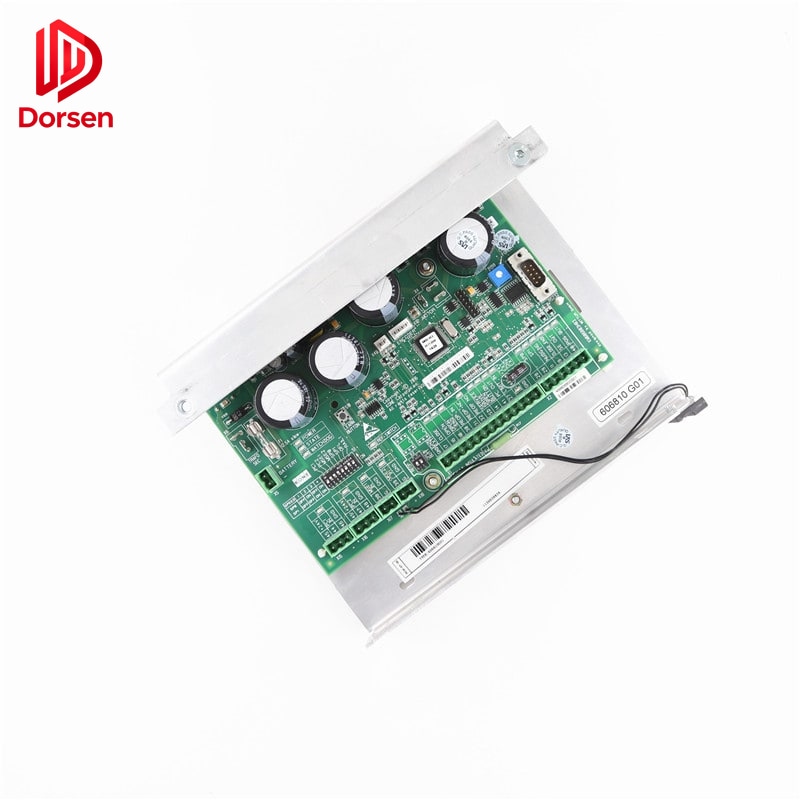
4.3 Control Board / Drive Module
| Symptom | Likely sub-component | Identification data needed |
|---|---|---|
| Operator motor does not run | Drive board or inverter fault | Board P/N from label |
| Erratic open/close speed | Drive parameter corruption | Controller model and software version |
| Fault code on display | Board-specific error | Fault code number and board P/N |
5. Common Identification Mistakes
5.1 Ordering by Elevator Model Instead of Operator P/N
Mistake: “I need a door operator for a KONE MonoSpace 500.”
Problem: MonoSpace 500 installations use different operator models depending on door width, manufacturing year, and regional variant.
Solution: Always provide the operator nameplate P/N, not the elevator model name.
5.2 Ignoring Revision Suffixes
Mistake: Ordering KM950278G02 when the installed unit is KM950278G03.
Problem: Revision changes may include different mounting holes, connector types, or motor windings.
Solution: Photograph the exact P/N including all suffix characters.
5.3 Ordering Operator When Lock Hardware Failed
Mistake: Replacing the entire operator when the car will not start because the lock circuit is open.
Problem: Door appears closed but lock contacts are not making — a $50 contact set vs. a $2,000 operator assembly.
Solution: Diagnose lock circuit before ordering operator parts. See our door lock circuit troubleshooting guide.
5.4 Missing Door Width in Inquiry
Mistake: Sending operator model without door width.
Problem: Same operator model family has different linkage lengths for 900 mm vs. 1100 mm doors.
Solution: Always include measured clear opening width.
6. Information to Include in Your Inquiry
A complete door operator inquiry should contain:
- Nameplate photo — full operator nameplate with all fields legible
- Mounting context photo — show operator orientation in the car
- Door type and width — center/side opening, width in mm
- Elevator brand and controller type — from car data plate
- Fault description — what happened, when, and whether it is intermittent
- Sub-component scope — complete operator or specific part (hanger, knife, board)
- Quantity and destination — for lead time and shipping method
7. After Receiving the Replacement
7.1 Pre-Installation Verification
| Check | Action |
|---|---|
| P/N match | Compare received unit P/N to ordered P/N |
| Mounting dimensions | Verify bolt holes and bracket geometry against existing |
| Connector type | Confirm electrical connector matches controller cable |
| Motor rotation | Verify direction marking matches original |
| Included hardware | Check for belts, couplings, and mounting bolts in package |
7.2 Installation and Commissioning
- Lock out controller and verify zero voltage
- Document original wiring before disconnecting
- Install operator and reconnect per original routing
- Adjust door open/close timing and speed per controller parameters
- Verify lock engagement at every floor
- Test in automatic mode — full cycle at each landing
- Check door close force and nudging function
8. Preventive Maintenance to Extend Operator Life
| Task | Frequency | Benefit |
|---|---|---|
| Clean door tracks and sills | Quarterly (high-traffic lobbies) | Prevents binding and motor overload |
| Check door belt tension | Semi-annual | Prevents slip and incomplete close |
| Lubricate hanger rollers | Annual | Reduces noise and bearing wear |
| Inspect door knife roller | Every visit | Catches wear before lock engagement fails |
| Verify lock contact resistance | Annual | Prevents no-start callbacks |
DORSEN supports maintenance contractors with OEM-compatible door operators, hangers, door knives, and control boards — with pre-shipment specification verification to reduce wrong-part deliveries. Send nameplate photos through our quote page for confirmation within one business day.